


Slaughterhouse: Chasing the American Dream

The American Dream Nightmare
Imagine it: you've crossed land and sea, a journey that took months. You most likely have a young family, babies, children, and a wife to support. You’ve arrived in the USA, and if you’re lucky, you’ve made it to your final destination without a con man scamming you out of the little money you have. What are you met with?
You were promised $1 a day. And yes, you got that. But you didn’t realise that $1 a day meant just $0.17 an hour, well below the national average of $0.22. Sure, if you’d been at the plant a while and gained some skill, you could earn up to $0.50 an hour, but that would require you to take on the most dangerous jobs, and the cost? Your body or maybe even your life.
So, you’re earning far less than average, which means you and your family end up living in squalid neighbourhoods, typically built around the meatpacking plants and animal stockyards. You’re well and truly below the poverty line, barely making ends meet. Pretty soon, your wife will have to join you at the plant. You both worry about who’s going to look after the baby and the youngest children. Your eldest two, 14 and 15, are already working alongside you at the plant.

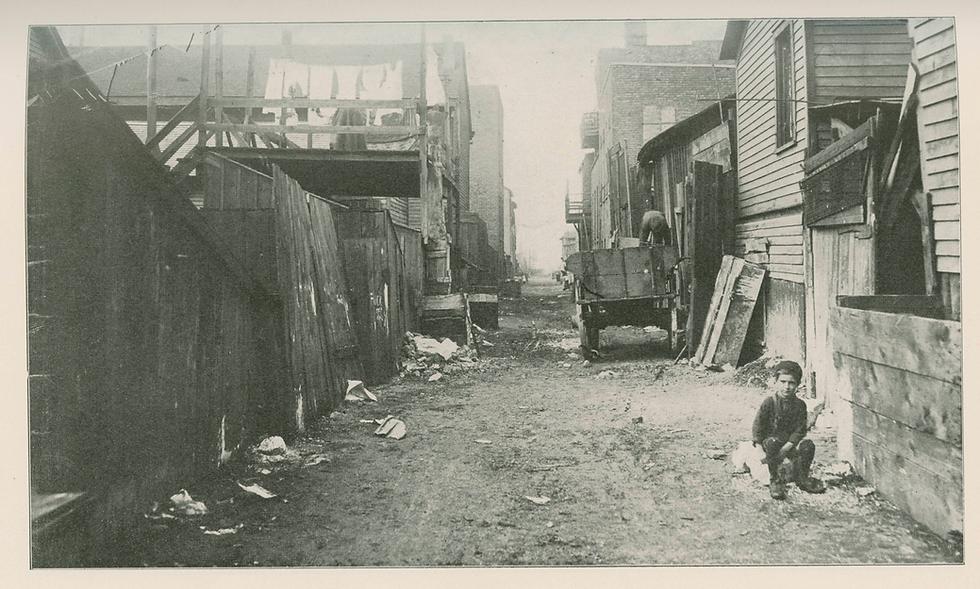

“One became aware of Packingtown long before stepping down from the streetcar near the great stone gate of the Union Stockyards. The unique yards smell—a mixture of decaying blood, hair, and organic tissue; fertilizer dust; smoke; and other ingredients—permeated the air of the surrounding neighborhoods.” Historian, James Barrett, in his study of immigrant labor in Chicago.
All around you are men like you. They’ve allowed themselves to be swallowed up by despair. They came here full of hope and optimism, only to be crushed by backbreaking work that has left them exhausted, living off pennies. Too many of them have turned to the bottle.
What are the conditions like, you ask? You’re expected to work 10+ hours a day, six days a week. Requesting even a single day off could result in immediate dismissal. Arrive even a minute late? We’re docking you an entire hour’s pay.
But it isn’t just the financial abuse that wears you down. What really breaks you is the physical and psychological toll of slaughtering the animals, which, during this time, was anything but humane.


But if you don’t show up and do your job day in, day out, you and your family will be out on the street. The company owns the house you live in. They own most of the houses, if you can call them that, around the plant. They charge rents far above a reasonable price, but you don’t know that because you’re new to the country. They dock the rent directly from your pay. If they allow you the option of purchasing one of their homes, the interest rates will be inflated, making it nearly impossible to ever pay it off. Fail to make your payments, or get injured on the job? You’ll be thrown out onto the streets. The company isn’t worried, they’ve got more like you arriving fresh off the boat every week.
The following article is inspired by my husband’s great-grandfather, Anton Swaboda, who emigrated to the USA from Czechoslovakia with his family in 1904. He was chasing the American Dream, but like so many from Eastern Europe, he ended up in the meatpacking industry. A verifiable hell on earth.
CONTENT WARNING This article has depictions and images of animal slaughter and inhumane working conditions from the early 20th century. Please proceed with caution.
Anton Swaboda moved to the USA in 1904, which means the first time we see him on a census is 1910. It is on this census that we can see Anton had secured work with Cudahy Meat Packing.
I’ve had no luck locating the immigration documentation so far for the Swaboda’s, but we know the family ended up in Omaha, Nebraska. This isn’t surprising. Between the 1880s and 1910s, Omaha saw a large influx of Eastern European immigrants - particularly Czechoslovakians. By 1900, they were the fourth-largest immigrant group in the city.
The Swabodas settled in South Omaha, near the stockyards and packing houses. This area would come to be known as Little Bohemia. The Czech community here centred around social events and gatherings at places like The Prague Hotel, which is still standing today.

Meat Packing: A Quick History
Meatpacking is really just a sanitised term for the slaughter, butchering, and packaging of animals for food. The practice itself dates back to the 1600s, but it didn’t become industrialised until the late 19th and early 20th centuries. Why? The Industrial Revolution.
With the advent of machines, more and more people were pushed out of farm work and into densely populated cities, forced to find new ways to earn a living. Slaughtering and butchering your own animals in the middle of an urban jungle was impractical, and most men simply wouldn’t have had the time.
Before industrial meatpacking, dressing a single cow was a highly skilled, labour-intensive process. It could take a trained butcher several hours, sometimes most of a working day, to fully skin, gut, and prepare the animal for sale, especially if done without mechanised tools or refrigeration. It wasn’t a task for the untrained, and it certainly wasn’t fast.

As urban populations grew, so did the demand for prepared and packaged meat. This demand soared, and the companies that would later be known as The Big Five capitalised on the opportunity. They opened massive abattoirs and meatpacking plants. Beginning in Chicago, with the Union Stockyards, arguably the most infamous site in the meatpacking industry’s history. From there, meatpacking plants began to crop up across the American Midwest, each one modelled on the Chicago blueprint.
By the early 20th century, when Anton and his family arrived in Omaha, meatpacking was BIG business. These corporations weren’t just responsible for slaughtering and preparing meat to be shipped off to the four corners of the world. They were the force behind the American railroads, labour markets, trucking, and national transportation systems.
They were responsible for innovations like refrigerated railcars and early assembly lines, methods that would later inspire none other than Henry Ford.

And while Big Meat presented itself to the public as clean, efficient, and forward-looking, there was a soft, dirty underbelly just waiting to be exposed.
The corporate titans behind the Big Five believed themselves untouchable. They were the very definition of profit over people. At their peak, they were turning over more than $1 billion USD in annual sales, more than the entire U.S. federal budget in 1900. Adjusted for inflation, that’s roughly $35 billion USD today.
So who were the “Big Five”?
Swift
Armour
Cudahy Packing Company (Anton worked for them)
Wilson
Morris (acquired by Armour in 1923)

This time period was known as the Gilded Age of Business, a period of rapid industrial expansion that unfolded with little to no government oversight. The result? The well-being of employees wasn’t even a consideration. These megaliths of industry wanted their plants built as quickly as possible, and they wanted workers processing meat at an even faster pace. It was a recipe for disaster. The conditions were filthy and extremely dangerous, for both the animals and the workers.
Union Trouble & the Rise of Immigrant Labour in Meatpacking
By the turn of the century, labour unions had begun to seriously challenge the major meatpacking companies. The Knights of Labour had tried to organise meatpackers as early as the 1880s, but struggled to bring workers together. The real push began with the American Federation of Labour in the 1890s, and later with the formation of the Amalgamated Meat Cutters and Butcher Workmen in 1897.
Fast forward to the early 1900s, and unions were staging strikes to demand higher wages, shorter shifts, and safer working conditions.
Do you think the Big Five listened to the unions and thought, “Maybe we should treat our employees like human beings”? No, of course not.
“We consider the demand of the union for an advance in wages of unskilled labor entirely unwarranted by industrial conditions. We could not concede it, and proposed to submit the question to arbitration, which the union declined. Every department is kept running, however. We have had applications from hundreds of unemployed men for positions at less wages than we have been paying, and every day expect to increase our output.” Arthur Meeker, Armour & Co. Packing House Strike Involves 45,000 Men. The New York Times, 13 Jul. 1904.
In response, these companies began deliberately recruiting large numbers of immigrant workers. They even sent representatives overseas, targeting the peasantry with promises of a better life. Recruiters spoke of the American Dream and wages as high as $1 a day. In poverty-stricken parts of Europe, $1 a day sounded like a fortune. What they failed to mention was the cost of living in the United States, where $1 a day would barely get you by.

Most of these workers came from Eastern and Southern Europe: Bohemians (Czechs), Slovaks, Poles, Croatians, and others. From the corporation’s perspective, these workers were:
Less likely to unionise—at least initially—due to language barriers and unfamiliarity with American labour politics.
Easier to control, thanks to their desperation for work.
Willing to accept lower wages and worse conditions.
And this tactic worked, at least in the short term. Companies actively pitted ethnic groups against each other to weaken union solidarity, offering slightly better pay or conditions to whichever group was willing to break a strike.
Upton Sinclair and The Jungle
In 1904, Upton Sinclair, a writer and outspoken socialist, went undercover for seven weeks in a meatpacking plant. He used his time and experience there to write the bestselling novel The Jungle, which was first serialised in a socialist newspaper. The book, an amalgamation of true events he heard and witnessed, detailed the horrifying abuses taking place in the industry.
However, when it was released, the American public was far more disturbed by the vermin and unhygienic practices than by the human suffering it exposed, prompting
Sinclair’s now-famous quote:
"I aimed at the public's heart and by accident I hit it in the stomach".
So what did Mr. Sinclair witness during his seven weeks undercover? I’ll let him speak in his own words, with this excerpt from the opening chapter of The Jungle:
"They are able-bodied men here who work from early morning until late at night, in the ice-cold cellars with a quarter inch of water on the floor -- men who for six or seven months in the year never see sunlight from Sunday afternoon till the next Sunday morning -- and who cannot earn three hundred dollars in a year. There are little children here, scarce in their teens, who can hardly see the tops of work benches -- whose parents have lied to get them their places -- and who do not make the half of three hundred dollars a year..."

He gave us details about the kinds of positions men, women, and even children held on the line.
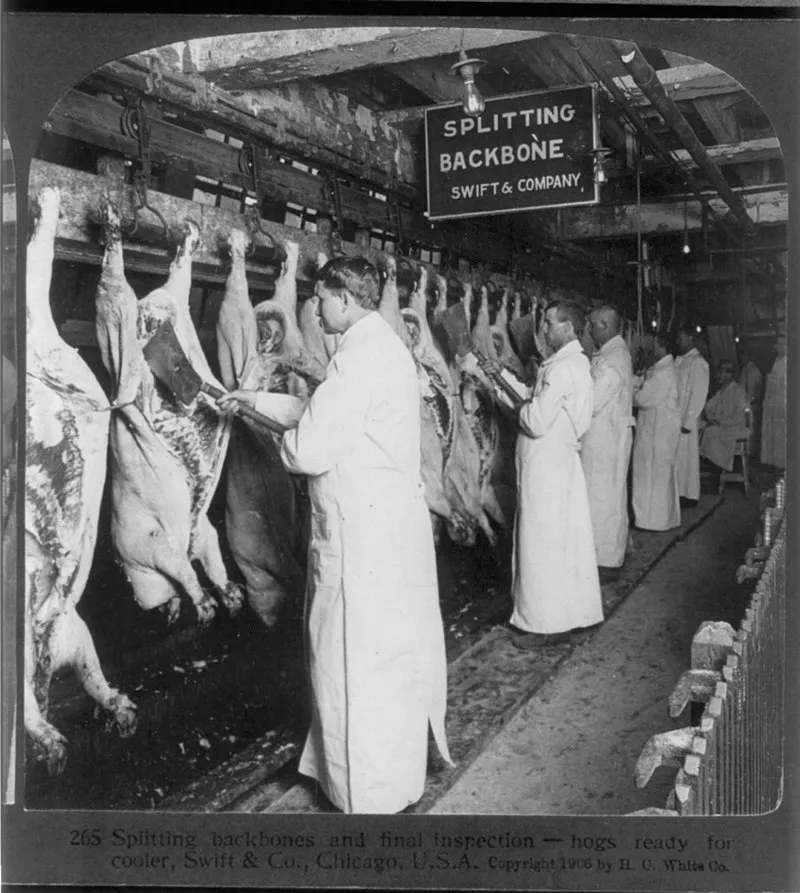
Splitters: The most skilled workers in the plant, they could earn up to 50 cents an hour. From dawn until dusk, their job was to cut the hogs cleanly down the middle.
Cleaver Men: Often large and muscular, these men had two helpers who hauled the carcasses onto the bench. The helpers held the body in place while the cleaver man hacked it into smaller pieces with a two-foot-long blade. From there, the meat was dropped down filthy wooden chutes to be smoked, pickled, or packaged fresh. But where had this meat come from?
The Killing Floor: Every hour, between 400 and 500 cattle were slaughtered here. It was a large, single-floor workspace. First, the cattle were driven into separate pens by men wielding electric prods called goads. There was no space for the animals to turn around or move.
The Knockers: The next cog in the machine. Each carried a large sledgehammer and worked their way down the line of cattle, waiting for the moment to deliver a blow to the skull. The room was filled with a hypnotic rhythm—thud, thud, thud. Once the animals were incapacitated, the pen side was raised, and they were ushered out to the next station.
The Killing Bed: A shackle was placed around one leg of each animal. They were then jerked up into the air in groups of about 15 to 20 at a time. The killing beds were manned by highly specialised labourers, all working at breakneck speed. Each man had one task and one task only. First up came...
The Butcher: His job was to bleed the animal with one swift slice of the blade. Other lower-ranking labourers followed behind him, sweeping pools of blood into small holes in the floor meant to serve as drains. These were wholly insufficient. Men worked in half an inch of slick, coagulating blood. The carcass was left for a few minutes to bleed out, then let down to the floor.
The Headsman: Next in line, his job was to remove the head with a couple of quick blows.
The Floorsman: He sliced the skin down the centre, then made several more slits until the carcass was sufficiently skinned. It was strung up again while another workman inspected the hide. The skin was then rolled up and shoved into yet another filthy hole in the floor.
Finally, the remaining carcass moved along the line to other men.
"…men to cut it, and men to split it, and men to gut it and scrape it clean inside. There were some with hose which threw jets of boiling water upon it, and others who removed the feet and added the final touches. In the end, as with the hogs, the finished beef was run into the chilling room to hang it appointed time" Upton Sinclair, The Jungle
The Filth That Hit America
It wasn’t just about the blood and gore.
It was the stench, the maggots, the rats, and the meat that rotted in plain sight before being scrubbed down, repackaged, and sent off to be eaten by an unsuspecting public.
In the freezing Midwestern winters, workers would stand for twelve hours straight in cellars so cold that the blood froze on their boots. Frostbitten fingers stiffened around knives. Ice crept into their clothes. They left work shivering, soaked in gore, only to return the next morning to do it all again.

Then came summer, a hell of its own. The temperatures soared inside the slaughterhouses, where there was no ventilation. Sweat poured from men’s faces and mixed with the blood. Flies descended in clouds, thick enough to coat the walls. The meat spoiled on the hooks, but that didn’t stop the production lines. Spoiled meat was scrubbed, redyed, and repackaged. Some of it was even mixed with fresher meat to disguise the smell.
Maggots hatched in corners and wormed their way into the cracks between floorboards. Dead rats fell into open vats. Sometimes workers did too.
Upton Sinclair described the floor of the killing rooms as being permanently slick with blood and offal, and said the smell alone was enough to make a man faint. And yet the men stayed. They stayed because there were mouths to feed and rent to pay, and because the company owned everything.
The meatpacking companies insisted everything was clean. Their brochures boasted about progress, about scale, about efficiency. They made meat a modern marvel. And Americans believed it… until they didn’t.
Sinclair's Legacy
Upton Sinclair had hoped to awaken the American people to the mistreatment of workers and force change in the industry. But the fight would be long and bitter. A vocal socialist, he originally published The Jungle as a serial in a socialist newspaper. Sinclair’s politics were immediately used to discredit him.
None other than President Theodore Roosevelt accused Sinclair of exaggerating the horrors in order to push a socialist agenda. Many Americans, already wary of radicalism, hesitated. Was the novel really truthful? Was it propaganda?
In reality, it couldn’t have been further from fiction. Sinclair’s depictions were not only accurate, but they were also often restrained. Many of the abuses he described were later confirmed by federal inspectors, journalists, and whistleblowers. One government report even noted that The Jungle “understated" the extent of the contamination and cruelty inside the slaughterhouses.
It would later be said that The Jungle did for the meatpacking industry what Uncle Tom’s Cabin did for slavery. It changed the way Americans saw their food—and the people who produced it.
But change didn’t come easily. The Big Five continued to dominate the food industry long after Sinclair’s book hit the shelves. They adapted their public image, but not their practices. Behind the scenes, little improved for workers. Their monopoly only tightened.
Real Reform or Political Theatre?
It wasn’t until 1917, more than a decade after The Jungle was published, that real federal scrutiny emerged. President Woodrow Wilson ordered the Federal Trade Commission to investigate the meat industry.
The report that followed in 1918 was scathing.
“Not only have [the packers] a monopolistic control over the American meat industry, but have secured control, similar in purpose if not yet in extent, over the principal substitutes for meat, such as eggs, cheese, and vegetable oil products, and are rapidly extending their power to cover fish and nearly every kind of foodstuff.”
The Big Five were no longer just meat companies; they were quietly becoming food empires.
The FTC’s findings led to the Packers and Stockyards Act of 1921, a law designed to regulate fair competition, limit corporate monopolies, and create accountability. It was one of the first serious attempts by the federal government to rein in the power of America’s industrial food giants.
But even then, worker welfare did not drive the reform. It was economic fear, fear of monopoly, price gouging, and public backlash. The reforms focused on markets, not people. Animals got inspected. Meat got regulated. But the men and women on the killing floor? For them, real protections were still decades away.
Sweet Home Alabama
After at least a decade working in the Cudahy packing plant in Omaha, Anton Swaboda did something few immigrants managed—he left the industrial machine behind.
By the 1930s, he had moved south to Robertsdale, Alabama, where he purchased farmland.
We can’t say for sure how the opportunity came about, but there are a few likely explanations. Czech and Slovak immigrants had already begun settling in southern Baldwin County by the early 1900s. It’s possible Anton had relatives or countrymen who had already written back with news of affordable land and better living conditions.

At the time, land agents and Southern railroad companies were actively recruiting European immigrants from Northern industrial cities. They offered cheap farmland and promised a way out of crowded urban neighbourhoods. For a man like Anton, who had endured years in the noise and filth of the packing plants, it would have been an appealing offer.
For a man from Czechoslovakia, farming was likely in his blood, familiar work, hard but honest. So he went. He bought land, raised his family, and left the stench of the stockyards behind. In the red soil of Alabama, he started again.
Knext Gen Genealogy is a reader-supported publication. To receive new posts and support my work, consider becoming a free or paid subscriber on Substack:
Or with a one-time donation via BuyMeACoffee:
Want to work with me on your family history? You can find my service and price list here.
For more information about the Meatpacking Industry, I recommend the following documentaries, available on YouTube:
SOURCES:
The Jungle and the Community: Workers and Reformers in Turn-of-the-Century Chicago – The Newberry Digital Collectionshttps://dcc.newberry.org/?p=14384
The Jungle by Upton Sinclair (1906), full text via Project Gutenberghttps://www.gutenberg.org/ebooks/140
Federal Trade Commission Report on the Meatpacking Industry (1919) – HathiTrust Digital Libraryhttps://babel.hathitrust.org/cgi/pt?id=uc1.b2991452
The Meatpacking Industry – Library of Congress Primary Sourceshttps://www.loc.gov/classroom-materials/meatpacking-industry/
History of Chicago’s Union Stock Yards – Encyclopedia of Chicagohttp://www.encyclopedia.chicagohistory.org/pages/790.html
Wikimedia Commons – Public Domain Images of Meatpacking (1900s–1920s)https://commons.wikimedia.org/wiki/Category:Meat_industry_in_the_United_States


Comments